
From Digital Citizen to Digital Opportunity
A follow-up to the Digital Citizen framework that connects individual competencies and personalized learning resources to Michigan’s digital-equity indicators and the six dimensions of the Digital Opportunities Compass.
From Digital Citizen to Digital Opportunity
Aligning an Individualized Competency Model with Michigan’s Digital Equity Plan and the Digital Opportunities Compass
This article follows the earlier Digital Citizen discussion, which proposed eight transferable capabilities: Connect, Identify, Navigate, Communicate, Create, Evaluate, Protect, and Participate. The next question is whether that individual competency model aligns with Michigan’s digital-equity strategy and the broader systems view offered by the Digital Opportunities Compass.
Digital citizenship is often presented as a curriculum: a sequence of lessons about devices, online behavior, information literacy, privacy, and safety. That approach can be useful, but it is not sufficient for the challenge Michigan faces. A resident may complete a digital-literacy course and still be unable to afford a reliable connection, access an appropriate device, authenticate to an essential service, navigate an inaccessible website, recognize a fraudulent message, or obtain timely help when something goes wrong. Conversely, a person may already possess many relevant capabilities but be asked to repeat introductory instruction because a program has no way to recognize what that person can already do.
The Digital Citizen model offers a different starting point. Rather than defining digital readiness by course completion or familiarity with a particular application, it asks what a person can demonstrably do across the digital systems that increasingly mediate healthcare, education, employment, government, finance, and community life. Its eight domains—Connect, Identify, Navigate, Communicate, Create, Evaluate, Protect, and Participate—describe transferable capabilities. MyChart, an online banking service, a learning management system, and a government benefits portal become contexts in which those capabilities are applied, not separate definitions of digital competence.
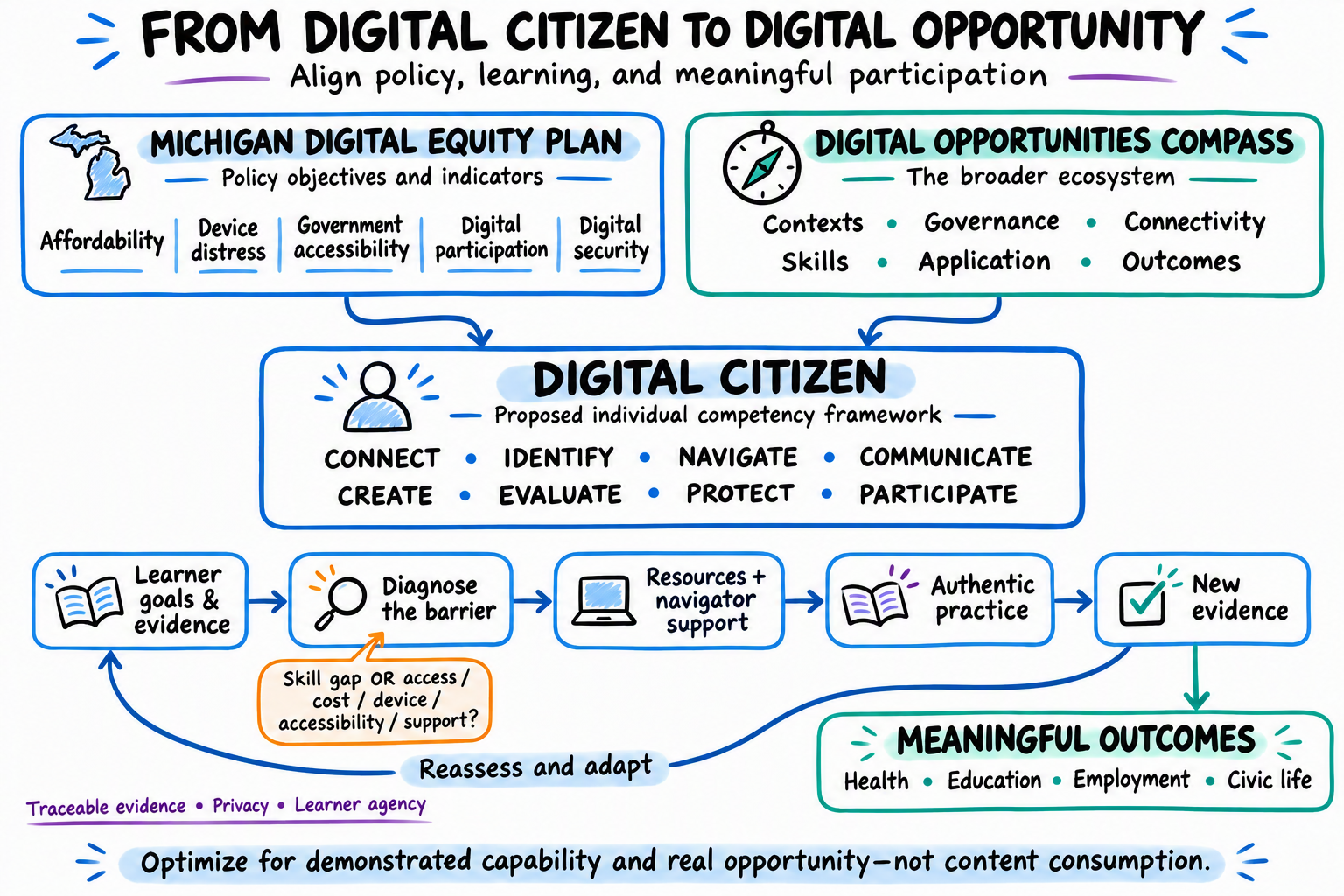
That individual focus becomes considerably stronger when it is situated within two larger frameworks: the State of Michigan Digital Equity Plan and the Digital Opportunities Compass. The Michigan plan establishes statewide goals, priority populations, implementation strategies, and measurable indicators. The Compass explains the broader ecosystem through which connectivity becomes meaningful opportunity. The Digital Citizen model can supply the missing instructional and competency layer between those systems and the individual resident.
Three frameworks, three different jobs
The three frameworks should not be collapsed into one another. Each answers a different question.
The Michigan Digital Equity Plan asks what conditions Michigan must improve and what outcomes the state is trying to advance. Michigan’s vision is to close the digital divide by 2030 and create a digitally connected and inclusive future in which residents and communities can use affordable high-speed connectivity, devices, and applications to improve their quality of life. The plan explicitly moves beyond network availability by including devices, technical assistance, training, adoption, and effective utilization (Michigan High-Speed Internet Office [MIHI], 2024).
The Digital Opportunities Compass asks how the larger digital-opportunity ecosystem works. It expands the discussion beyond access and affordability through six interdependent components: Contexts, Governance, Connectivity, Skills, Applications, and Outcomes (Rhinesmith et al., 2023). The Compass is especially valuable because it does not treat digital skills as an isolated remedy. Skills matter, but so do the conditions in which people live, the institutions and policies that shape access, the infrastructure and support available to them, the applications through which they participate, and the outcomes they can realize.
The Digital Citizen model asks what an individual must be able to do to participate with safety, confidence, effectiveness, and agency. It provides a way to define observable competencies, assess existing capabilities, identify specific gaps, connect those gaps to appropriate learning resources, and collect evidence that the learner can transfer a capability into an authentic setting.
The relationship can therefore be stated simply:
Michigan establishes the public-policy objectives. The Digital Opportunities Compass explains the surrounding ecosystem. Digital Citizen defines and supports the capabilities a person needs to act within that ecosystem.
Connecting the eight capabilities to Michigan’s indicators
Michigan’s plan organizes measurable objectives around five indicator areas: Affordability, Device Distress, Digital Government Accessibility, Digital Participation, and Digital Security (MIHI, 2024). These indicators do not correspond one-to-one with the eight Digital Citizen domains, nor should they. The state indicators are measures of conditions and participation, while the Digital Citizen domains describe capabilities that may influence more than one indicator.
Connect directly supports the state’s concern with device distress, but it should not be reduced to basic device operation. A person demonstrates Connect when they can establish the technical conditions needed to accomplish a task: operate an appropriate device, connect through Wi-Fi, cellular, or wired service, use common peripherals, adjust accessibility settings, recognize a connectivity problem, and locate an alternative connection or source of help. At the same time, a failed connection may reveal an infrastructure or affordability barrier rather than a competency gap.
Identify covers digital identity, accounts, credentials, multifactor authentication, identity verification, and account recovery. It supports Digital Government Accessibility and Digital Security because access to essential services increasingly requires people to prove who they are without exposing more information than necessary. The durable competency is not “use MyChart” or “sign into a particular state portal.” It is the ability to establish and manage digital identity across unfamiliar systems.
Navigate includes locating reliable online services, understanding interfaces, completing forms, uploading and retrieving documents, following digital workflows, and recovering when the expected path changes. It is central to Digital Government Accessibility and Digital Participation. A resident who can find a government website but cannot determine which application applies, preserve progress, submit documentation, or interpret a confirmation has not yet achieved meaningful access.
Communicate includes email, messaging, video meetings, collaborative platforms, and the judgment required to select the right channel. It contributes to participation in healthcare, education, employment, and civic life. Communication competence includes more than operating a microphone or sending a message. It also includes recognizing audience, preserving privacy, communicating clearly, and knowing when a digital channel is inappropriate for the urgency or sensitivity of the situation.
Create moves the resident from consumption toward agency. It includes producing, organizing, adapting, and sharing digital content; completing applications; creating a résumé or portfolio; contributing information to a community process; and using digital tools to solve problems. This domain helps connect Digital Participation to education, employment, entrepreneurship, civic engagement, and community development.
Evaluate addresses information, media, data, and increasingly artificial-intelligence literacy. It includes assessing source credibility, comparing claims, identifying manipulation, recognizing uncertainty, and determining whether digital information is appropriate to the decision at hand. Evaluate strengthens both Digital Participation and Digital Security because misinformation, fraud, low-quality advice, and automated content increasingly overlap.
Protect includes privacy, cybersecurity, scam recognition, safe account practices, software updates, data sharing, consent, incident response, and recovery. It maps most directly to Michigan’s Digital Security indicator, but it should be taught as an enabling capability rather than a reason to withdraw from digital participation. The goal is not to make residents fearful of digital systems. It is to give them sufficient understanding and support to participate with informed confidence.
Participate is where the other seven capabilities become meaningful. It refers to using digital systems to pursue goals in healthcare, education, employment, government, finance, public safety, and community life. Participation is not simply logging in. It means successfully completing a transaction, obtaining care, learning something, applying for work, accessing a benefit, contributing to a civic process, or communicating with an institution.
The Compass prevents us from diagnosing every problem as a skills problem
The most important contribution of the Digital Opportunities Compass to an individualized learning model may be diagnostic discipline. If a resident cannot complete an online task, it is easy for an institution to conclude that the person lacks digital skills. The Compass requires a wider investigation.
The barrier may be Connectivity: service is unavailable, unaffordable, unreliable, or too constrained for the application. It may arise from Context: the learner’s language, disability, work schedule, transportation, prior experience, culture, geography, or immediate goals. It may be a Governance failure: fragmented programs, unclear eligibility, weak referral relationships, inaccessible policies, or no accountable organization able to help. It may be an Application problem: the website is poorly designed, incompatible with the resident’s device, inaccessible, or unnecessarily complex. It may be an Outcome problem: the digital transaction is completed, but it does not produce a meaningful benefit. Only some failures are primarily Skills failures.
This distinction matters ethically and operationally. Training cannot repair an unavailable broadband connection. A video lesson cannot make an inaccessible government form accessible. Repeating password instruction will not help a resident whose account-recovery process depends on a telephone number they no longer possess. Asking someone to practice telehealth will not solve the absence of a private location or a clinically appropriate device.
The initial rule for an individualized Digital Citizen system should therefore be:
Before assigning instruction, determine whether the barrier is competency, connectivity, affordability, device suitability, accessibility, service design, trust, governance, or support.
This is where digital navigation becomes more than tutoring. A capable navigator helps distinguish the learner’s competency gap from the surrounding system gap, resolves what can be resolved, and routes unresolved structural barriers back into program and policy learning.
From a standard curriculum to individualized instruction
A reference curriculum can still be organized around the eight domains, but it should not assume that every learner must complete every lesson in the same order. The better process begins with performance evidence.
A learner might be asked to connect a device to a designated network, sign into a training account using multifactor authentication, locate a specified service, download and retrieve a document, distinguish a suspicious message from a legitimate one, and join a practice video interaction. Performance can be recorded through observable states such as unable, assisted, guided, independent, and independently able to troubleshoot. These levels describe the amount of support demonstrated in a specific performance. They are not scores of the learner’s worth or intelligence.
The system then compares demonstrated capability with the capability required for the learner’s goal. If someone wants to use a patient portal and can already connect, authenticate, and navigate independently but cannot judge whether a message requesting personal information is legitimate, the relevant gap is not “digital literacy.” It is a narrower Evaluate or Protect competency. The system should select the smallest sufficient intervention, generate new evidence, and reassess.
Learning resources should consequently be modeled by their instructional relationship to a competency. A resource may introduce, explain, demonstrate, provide practice, reinforce, extend, or assess a capability. A five-minute illustrated explanation, an interactive simulator, a guided session with a navigator, a peer-supported activity, a Coursera lesson, a library workshop, and a real-world task can all support the same competency in different ways.
Resource selection should follow a clear sequence. First, determine whether the learner’s current state is known. If evidence is insufficient, use a diagnostic task before assigning instruction. Second, verify prerequisites. Third, select the instructional function appropriate to the gap. Fourth, filter resources by accessibility, language, device compatibility, bandwidth requirements, availability, licensing, and the learner’s context. Fifth, choose the smallest sufficient intervention. Finally, require evidence of performance before treating the gap as closed.
Completion is not mastery. Watching a video about multifactor authentication documents participation in a resource. Independently authenticating to an unfamiliar training service, recovering from a failed attempt, and explaining why an unexpected approval request should be rejected provide evidence of capability.
Applications are where transfer becomes visible
The Digital Citizen framework should remain domain-independent, but assessment should occur through authentic applications. The Compass’s distinction among Skills, Applications, and Outcomes helps maintain this balance.
Consider the competency “authenticate securely to a digital service.” A learner might first demonstrate it in a healthcare portal. Later, the same capability may be required in an educational platform, an employer account, online banking, or a government service. The interfaces vary, but the underlying concepts remain recognizable: account identity, credentials, verification, multifactor authentication, recovery, and appropriate handling of requests.
This allows the system to distinguish initial performance from transfer. A person who memorizes one sequence of buttons may perform successfully in a familiar system without yet possessing a transferable competency. A person who understands the purpose and patterns of authentication is more likely to adapt when the interface changes.
The same principle applies across the framework. Connect can be demonstrated through telehealth, a virtual class, or a remote interview. Navigate can be demonstrated through a benefits application, a job portal, or a library catalog. Evaluate can be demonstrated through a health claim, a social-media post, a job advertisement, or an AI-generated answer. Participate can be demonstrated by completing an authentic task that matters to the learner.
The competency remains stable. The application supplies context. The evidence records what happened. The outcome asks whether it made a difference.
Measuring the path from instruction to opportunity
Programs often stop measurement too early. They count enrollments, instructional hours, devices distributed, and courses completed. Those are useful operational measures, but they do not establish that people gained transferable capabilities or achieved meaningful outcomes.
An aligned model should distinguish at least four levels:
- Instructional output: The learner received a resource or completed an activity.
- Competency evidence: The learner demonstrated a defined capability under stated conditions.
- Applied participation: The learner used the capability in an authentic domain.
- Outcome contribution: That participation contributed to something the learner or community values.
For example, completing a telehealth orientation is an instructional output. Joining a practice visit independently is competency evidence. Completing a real appointment is applied participation. Receiving appropriate care while avoiding a long and unnecessary trip is an individual outcome. If distributed virtual care improves access across a rural region, the cumulative effect may also contribute to a community outcome.
Attribution must remain careful. A digital-skills program should not claim sole responsibility for a health, employment, or educational outcome. Outcomes arise through multiple interacting conditions, exactly as the Compass suggests. The program can document its contribution by preserving the chain from context and barrier, to resource and support, to competency evidence, application, and outcome.
This is also where provenance becomes essential. Every competency assertion should identify the evidence supporting it, the context in which it was observed, the evaluator or system that recorded it, the date, the assessment method, and the applicable performance criteria. Every resource-to-competency relationship should identify who made the alignment, under which framework version, and on what evidence. That makes the system auditable and allows the competency framework and resource mappings to improve over time.
A continuous learning system for Michigan communities
Michigan’s plan emphasizes community engagement, collaboration, and solutions responsive to distinct community needs (MIHI, 2024). The Compass similarly frames measurement as a way to establish priorities, identify opportunities, and monitor progress (Rhinesmith et al., 2023). An individualized Digital Citizen model can turn those principles into a practical learning cycle.
The cycle begins with the resident’s goal and context. It identifies the barrier, distinguishes individual competency needs from structural barriers, selects an appropriate resource or support, observes performance, records evidence, and evaluates whether the learner could apply the capability successfully. Aggregated carefully and governed appropriately, these individual experiences can also reveal patterns: recurring account-recovery failures, inaccessible services, device shortages, language gaps, unreliable connections, or competencies for which no appropriate learning resources exist.
Those patterns should not remain trapped inside a learning management system. They should inform digital navigators, libraries, community organizations, service providers, application owners, funders, and policymakers. In this way, individualized instruction and policy learning become parts of the same system. The resident receives support tailored to a real goal, while the community gains better evidence about where the digital-opportunity ecosystem is failing or succeeding.
This is a natural role for the Digital Opportunities Intelligence Network. DOIN can connect competency definitions, learning resources, organizations, navigators, application contexts, indicators, evidence, and outcomes while preserving provenance. It does not need to replace Michigan’s reporting systems, the Compass, or a learning platform. Its role can be to make the relationships among them visible, queryable, and revisable.
The central design principle
The alignment among these frameworks produces a straightforward but consequential principle:
Digital Citizen should optimize for demonstrated, transferable participation, not content consumption.
Michigan’s Digital Equity Plan tells us which statewide conditions and outcomes matter. The Digital Opportunities Compass ensures that we see the whole ecosystem rather than reducing digital equity to either broadband deployment or personal skill. The Digital Citizen framework defines the capabilities through which individuals can act in that ecosystem. An individualized competency model then connects each resident’s goals and demonstrated needs to the next appropriate learning resource, human support, structural intervention, or policy response.
That is more than a digital-literacy curriculum. It is a competency-centered digital-opportunity system: one capable of recognizing what people already know, helping them close specific gaps, identifying when the barrier is not theirs to solve, and connecting learning to meaningful participation and outcomes.
References
Michigan High-Speed Internet Office. (2024). State of Michigan digital equity plan. Michigan Department of Labor and Economic Opportunity. https://www.michigan.gov/leo/-/media/Project/Websites/leo/Documents/MIHI/MIHI-Digital-Equity-Plan.pdf?hash=1BF348738152EB33FB55CE258F9C9672&rev=9416a254eb634d0f86b225f52bcdc0a5
Rhinesmith, C., Dagg, P. R., Bauer, J. M., Byrum, G., & Schill, A. (2023). Digital opportunities compass: Metrics to monitor, evaluate, and guide broadband and digital equity policy (Version 1.0) [Working paper]. Merit Network, Inc., & Quello Center for Media and Information Policy, Michigan State University. https://quello.msu.edu/divi/wp-content/uploads/2023/02/Digital-Opportunites-Compass-Paper-20220223.pdf